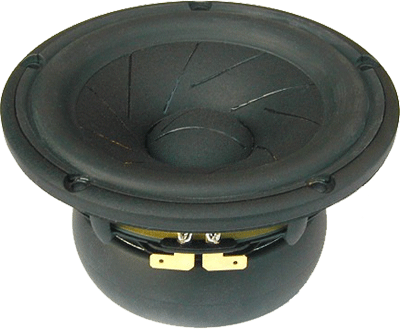
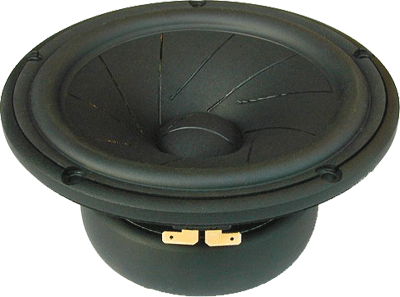
Thiele-Small parameters describe how a driver behaves at low frequencies. Three of them are enough to point towards the right enclosure: Fs, Qts and Vas.
Fs is the driver's free-air resonance. Qts expresses total damping, mechanical and electrical combined. Vas is the volume of air with the same compliance as the suspension.
A Qts below 0.3 calls for a reflex or horn loading. Between 0.3 and 0.5 either works. Above 0.5 the sealed box becomes the natural choice.
These figures shift with break-in: a new driver often shows an Fs ten to fifteen per cent above its settled value. Measuring before committing to a cabinet volume avoids an unpleasant surprise.
Two further parameters deserve attention: Xmax, the linear excursion limit, which sets the level attainable in the bass, and Sd, the radiating area. Their product gives displaced volume, the only figure that really counts down low.
Manufacturer figures describe a sample, not the driver in your hands. Units from the same batch commonly differ by a few per cent, and that is before break-in moves Fs again. For a sealed box the difference rarely matters; for a sharply tuned reflex cabinet it can shift the port frequency enough to hear.
Measuring your own is not difficult. A known resistor in series, a sound card and free software give Fs and Qts directly; adding a known mass to the cone, or a sealed test box of known volume, yields Vas by the delta method.