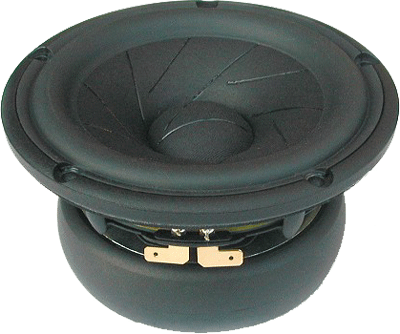
Scan-Speak has built drivers in Denmark since 1970 and remains the reference for high-end projects. Two families define the range: Revelator, recognisable by its sliced carbon-fibre cone, and Illuminator, which adds a low-distortion motor with a shorting ring.
What the brand really masters is the magnet system. Demodulation rings cut third-harmonic distortion, the kind heard as hardness in the upper midrange. That is what explains the price gap against drivers with comparable Thiele-Small figures.
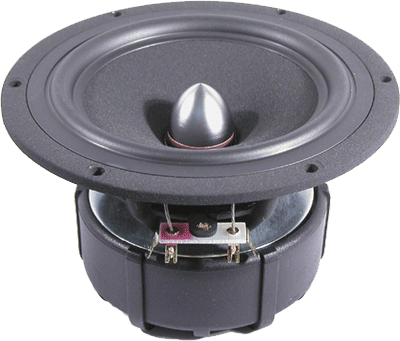
For a first build, a Classic-series mid-woofer is more forgiving than a Revelator: its response rolls off more gently and asks less of the crossover.
The Classic and Discovery ranges carry over part of the high-end engineering at lower cost. They are often the best value in the catalogue for a first serious project.
Ranges
| Series | Tweeter |
|---|---|
| Midrange | |
| Mid-Woofer | |
| Woofer | |
| Subwoofer | |
| Illuminator | |
| Revelator |
In practice
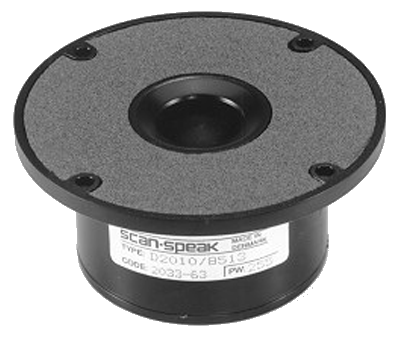
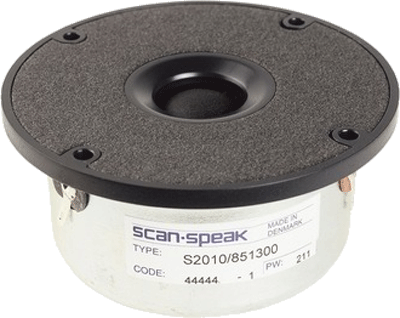
The usual mistake with Scan-Speak is buying above the rest of the project. A Revelator tweeter on an ordinary woofer and a crossover designed by formula will sound worse than a Classic pairing measured properly, because the expensive driver only shows its advantage once everything around it stops limiting the result.
The sliced cone on the Revelator mid-woofers exists to break up the standing waves that travel across a conventional cone. That shows as a cleaner transition into the tweeter rather than as more detail in isolation, which is why it is hard to hear on a bench and obvious in a finished enclosure.
Typical working ranges
| Tweeter | 1.8-20 kHz | Fs 450-700 Hz | Textile or beryllium dome |
|---|---|---|---|
| Midrange | 300 Hz-5 kHz | Fs 80-250 Hz | Sliced paper or fabric |
| Mid-woofer | 50 Hz-4 kHz | Qts 0.28-0.42 | Paper, carbon fibre |
| Woofer | 25-800 Hz | Qts 0.25-0.40 | Long-throw, cast basket |
| Subwoofer | 18-200 Hz | Qts 0.30-0.50 | High Xmax |