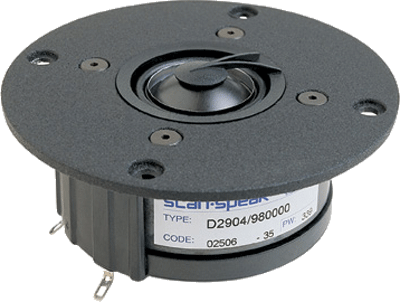
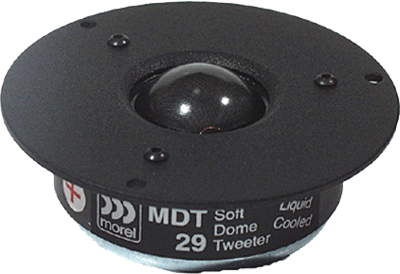
A passive crossover is not simply a cutoff-frequency calculation. Driver impedance varies with frequency, while the textbook formulas assume a constant resistive load.
Hence the value of correction networks: a Zobel linearises the woofer's rising inductance, a notch filter flattens the tweeter's resonance. Without them the real crossover point shifts by several hundred hertz.
The last step is always measurement. Two drivers with acceptable individual responses can overlap out of phase around the crossover and carve a hole in the combined response. Reversing tweeter polarity is the first test to run.
Filter order sets both slope and phase behaviour. First order preserves phase but demands drivers that work far outside their band. Third order protects the tweeter better at the cost of substantial phase rotation. Second order remains the common compromise, with the tweeter wired in reverse polarity.
Acoustic slope is not electrical slope. The driver already rolls off on its own, and the filter adds to that: a second-order electrical network on a driver that is itself falling can produce a fourth-order acoustic result. Designing by target curve rather than by component order avoids the confusion.
Baffle step is the other factor usually missed. Below the frequency where the cabinet stops supporting the radiation, output drops by up to six decibels. Compensating for it is part of the crossover, not an afterthought, and it is why a driver measured in a large baffle behaves differently in a narrow one.