The port tunes the enclosure volume to the intended frequency. Its area and length are chosen together: too narrow a tube generates air noise as soon as velocity passes roughly 17 m/s.
Flared ports push that threshold back by removing turbulence at the exit. For the same diameter the gain is obvious on sustained bass.
The Varioflex type allows the length to be trimmed after assembly, which saves rebuilding a cabinet when the measurement does not land on the intended tuning.
Verification is done with an impedance sweep: a correctly tuned reflex enclosure shows two impedance peaks separated by a dip, and that dip sits at the real tuning frequency.
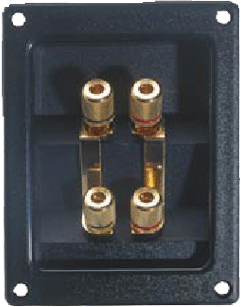
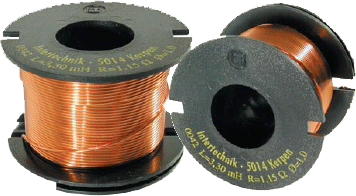
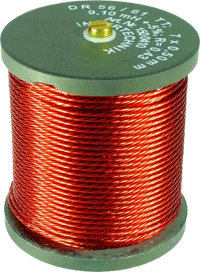
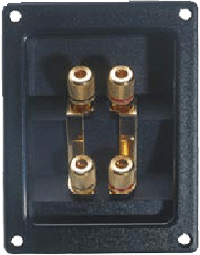
Variants
| References | Basic Line |
|---|---|
| Flared Port | |
| High Power | |
| Varioflex |
In practice
Port noise is easiest to hear on sustained low notes, not on percussion. If a bass line develops a breathy edge as the level rises while short transients stay clean, the port is too small for the excursion the driver is producing.
Tuning lower than the design intends is a common accident: a port cut slightly long, or a cabinet built slightly larger, both drop the frequency. The impedance sweep catches it in a minute, which is why it is worth running before the baffle is finally sealed.
Sizing and tuning
| Air velocity | Under ~17 m/s | Above it: chuffing | Flare helps |
|---|---|---|---|
| Flared ends | Removes turbulence | Same diameter | Higher clean output |
| Varioflex | Trim after build | Saves rebuilding | Tuning drift |
| Verify | Impedance sweep | Two peaks, one dip | Dip = real tuning |