Damping material absorbs standing waves inside the cabinet. Without it those resonances escape through the cone and the port as colouration in the midrange.
In a sealed box, generous filling raises the apparent acoustic volume by five to ten per cent. In a reflex design restraint is needed: too much material near the port smothers the tuning.
Materials differ mainly in flow resistance. Polyester wool works through the volume, open-cell foam acts at the surface, glued against the panels.
Parallel walls are the real problem: they create standing waves whose frequency follows directly from the spacing. Treating one of the two faces is usually enough to break the effect.
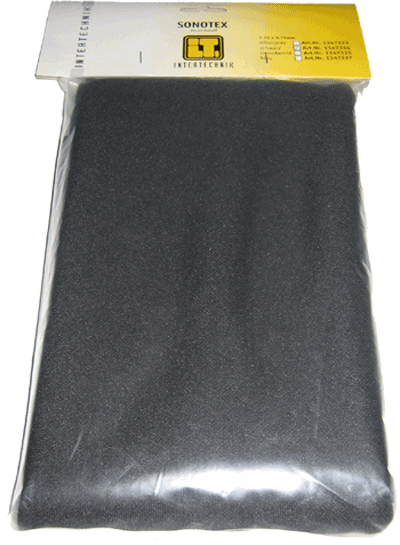
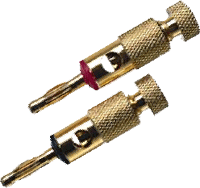
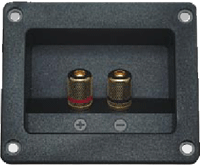
Variants
| References | Wool |
|---|---|
| Foam | |
| Sonotex | |
| Grille cloth |
In practice
Under-damping shows as a hollow, boxy quality on male voices, around the frequency whose half-wavelength matches the longest internal dimension. Over-damping in a reflex cabinet shows differently: the bass simply weakens, because the port has stopped working properly.
Work in stages. Add material, run a sweep, listen, then add more. It is far easier to judge the effect of each step than to diagnose a cabinet that was filled completely at the first attempt.
Material by enclosure type
| Sealed | Generous fill | Raises apparent volume | 5-10 per cent |
|---|---|---|---|
| Reflex | Restrained | Away from the port | Smothers tuning |
| Polyester wool | Works through volume | Flow resistance | General use |
| Open-cell foam | Surface treatment | Glued to panels | Parallel walls |